
Projected vs Actual Release Date
A projected release date is an agency's current estimate based on the sentence, credit rules, and facts in its file. It is not the actual date and time a person leaves. A pretrial detainee usually has no computed sentence-end date. Release depends on a court order, bond decision, dismissal, or another legal event. A sentenced county-jail detainee has a court term, while an IDOC prisoner may have separate projected parole and discharge fields.
Arrest date, jail receipt, sentence date, Projected Parole Date, Parole Date, Projected Discharge Date, and final discharge mark different events. Transfer is not community release. A person can leave Macoupin County Jail and enter another county, IDOC, federal, or immigration custody.
Find Macoupin Projected Release Dates
Choose the source by sentence type. The Macoupin court file explains the sentence. The Sheriff owns the county jail's physical movement record. The IDOC search is the main public source for a state prisoner's projected fields.
- Read the court case to identify pretrial, county-jail, or IDOC custody.
- For county custody, ask for the release or transfer entry and the court sentence.
- For IDOC, search by last name, IDOC number, or birth date and match conviction county and sentence facts.
- Read Offender Status, Projected Parole Date, Parole Date, Projected Discharge Date, and each Sentence Discharged? value.
- Confirm any change with the jail or IDOC.
The live IDOC search includes people incarcerated or on parole, not fully discharged people. Use Record Search for older history. The broader Macoupin released-inmate search explains the Sheriff, court, VINE, BOP, and ICE paths.
The official IDOC result shows how projected parole and projected discharge appear as separate fields.
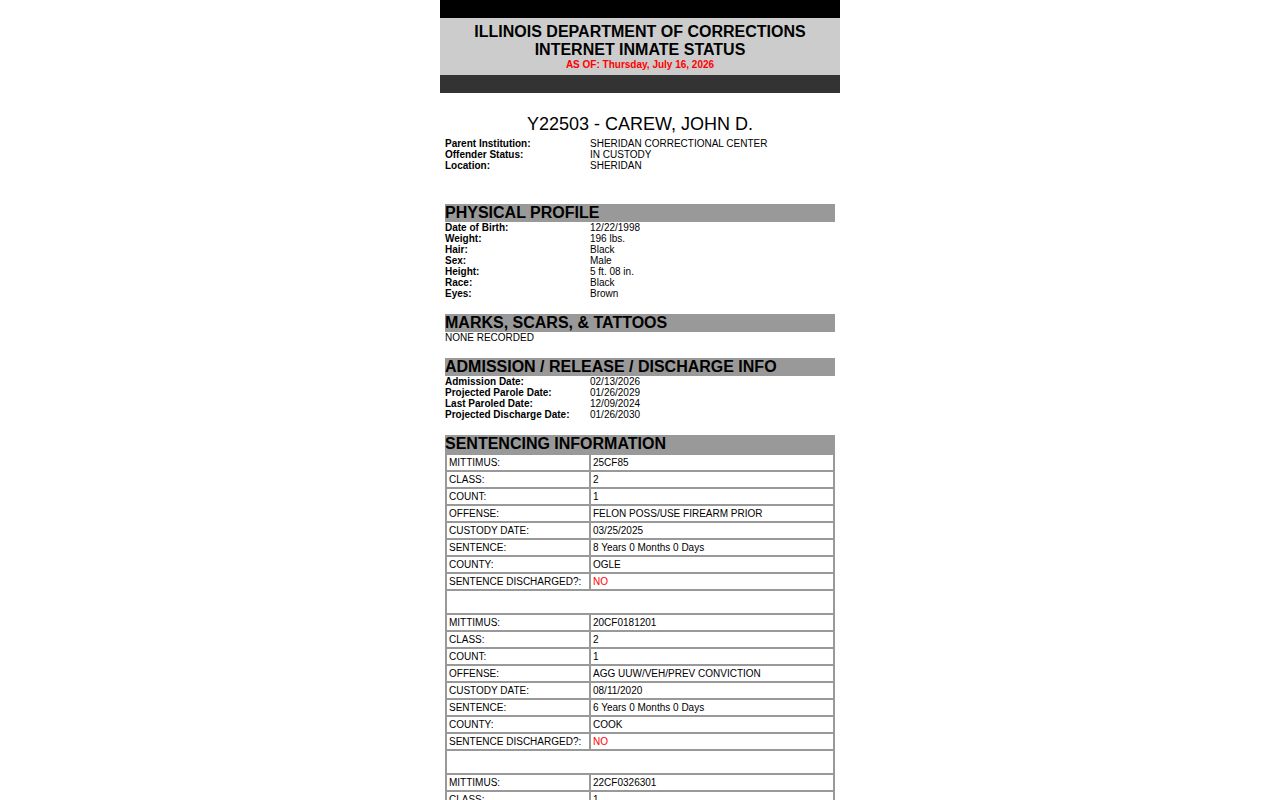
The interface example does not establish facts about any Macoupin case. Select the correct person and read every sentence count.
Good-Time Credit and How Release Dates Are Computed
Illinois sentence credit is offense-specific. Under 730 ILCS 5/3-6-3, some sentences receive day-for-day credit, while designated offenses require service of 75 percent, 85 percent, or 100 percent. Eligible program credit may also apply. The offense, sentence date, conduct, and credit eligibility shape IDOC's projection.
Those percentages are categories, not a safe calculator. Concurrent or consecutive counts, presentence credit, disciplinary loss, and restoration can change the result. IDOC computes state-prison credit from the controlling record.
County jail credit uses a separate framework, including the County Jail Good Behavior Allowance Act. No single Macoupin formula was verified for every jail sentence. Ask the court and Sheriff for the case-specific calculation and actual release entry.
Why a Projected Release Date Changes
A projected date moves when the custodian receives new legal or sentence information. The change may delay release, advance it, or replace expected community release with a transfer.
| Factor | Effect | Source |
|---|---|---|
| Credit earned or restored | May advance an eligible date | IDOC calculation |
| Disciplinary credit loss | May delay the date | IDOC record |
| Court order | Can alter sentence or authority | Signed order |
| Detainer or hold | Can cause transfer | Release entry and receiving agency |
| PRB action | Can affect release or supervision | IDOC and PRB |
| Multiple counts | One count may end while another remains | Full profile |
A detainer is a basis for another agency to assume custody. It means leaving one facility may not mean going home. Ask for the receiving authority when it is public.
Confirming a Release Date
For Macoupin County Jail, request the date, time, and authority for discharge or transfer. The court order supplies legal context, but the jail movement entry proves physical departure. For IDOC, compare the live profile with agency records. Register through the VINELink Check when the matching source offers notification.
VINE data can lag and speaks only for its reporting agency. Use the BOP locator for a federal prisoner and ICE for present immigration detention. A missing result is not proof of release.
Macoupin Parole Date Fields
Projected Parole Date predicts possible release from prison. Parole Date records actual release to supervision. Projected Discharge Date estimates the end of the sentence and supervision. Offender Status: PAROLE means the person is outside prison but still under IDOC control.
Most modern Illinois releases use MSR, not a discretionary parole grant. Legacy pre-1978 and youthful-review cases have distinct eligibility rules. Do not turn a projected field into an assumed hearing outcome.
Macoupin Sentences Sent to IDOC
When a Macoupin court commits a person to IDOC, the docket supplies the conviction and sentence. The Sheriff's transfer entry supplies the date and authority by which county custody ended. Neither means entry into the community. Search IDOC with the IDOC number when available. Otherwise use surname or birth date, then match conviction county, offense, custody date, and physical descriptors.
While status is IN CUSTODY, Projected Parole Date remains a calculated milestone. Read it beside Projected Discharge Date and all sentence fields. Illinois credit law has offense and date-specific rules, so no universal fraction should be subtracted.
After prison release, PAROLE, a past Parole Date, and a district strongly confirm the start of state community supervision. They do not establish final discharge. Later revocation can change custody and the computed date. Use the current profile and relevant PRB record, not an old capture.
Old Macoupin IDOC Release Dates
After the full sentence and supervision end, the person generally disappears from the IDOC lookup. That expected absence does not prove the old sentence or release date. First confirm an IDOC commitment rather than a county-only sentence. Then choose Record Search through IDOC Contact Us.
Provide full name, birth date, approximate receipt year, conviction county, known facility, and approximate release year. Request public identity, IDOC number, institution or status, admission and release dates, and sentencing facts. If a defined record copy is needed, use IDOC FOIA. A request for the whole master file may include confidential material and obscure the narrow date question.
Compare the archive with the sentencing docket and PRB discharge material. If a court record was sealed or expunged, follow court access rules. Do not rebuild restricted history from unofficial mirrors.
Public Record Search
Sponsored Results
Confirm Older Macoupin Release Dates
An archived inquiry should stay narrow. Ask for admission, actual parole or release, final discharge, and public sentence facts needed to verify chronology. IDOC policy identifies sentence calculations, status changes, release notices, checklists, and packets as record categories, but it does not make every item public. A defined request is more useful than a demand for the whole master file.
The court and IDOC can give different dates without a true conflict. The court records its sentence. IDOC applies statutory and earned credit. PRB records its own hearing or discharge act. The custodian records physical movement. Label each answer by source so a sentence date, projected milestone, and door-out date are never merged.
Identity checks remain vital in an old search. Use full legal name and birth date, then add the IDOC number, case number, conviction county, facility, or custody year. Common names and old aliases create false matches. If two profiles appear, compare sentence facts instead of choosing the first result.
When official sources disagree, keep both values and update dates. Ask the office that owns the field to review it. The movement entry is strongest for physical departure, the signed order for legal authority, and IDOC or PRB for supervision. Do not resolve the conflict through arithmetic.
A county-only sentence requires a different route. IDOC may have no record because the person was never committed to state prison. Use the Macoupin court judgment for the term and the Sheriff release entry for the actual exit or transfer. This prevents a valid no-result from being read as proof that an old state record vanished.
Macoupin Date Request Details
For a Sheriff request, identify the full name, approximate booking date, and case or booking number when known. Ask for the chronologically maintained entry showing receipt, discharge or transfer time, release authority, and receiving agency when public. This is a request for an existing custody record, not a request for staff to predict a date.
For IDOC Record Search, include the year received and known prison locations. If IDOC identifies a record that requires a formal copy request, follow its FOIA instructions. An archived inquiry and a FOIA request are related routes, but they are not interchangeable. The first helps locate public history; the second seeks defined existing records.
For the Circuit Clerk, request the disposition, sentencing order, mittimus, and later order changing custody or supervision. A mittimus is the court document directing confinement. The clerk can confirm legal authority and sentence terms, while the jail or IDOC supplies the actual physical-release record.